How-to guide
Which hook won?
A three-hook package's three hooks are compared on each account 72 hours and 7 days after they went out, by that network's own measure; make a video of another product with the winning hook, or a new package of the same product.
A three-hook package opens three videos of the same product with three different hooks. The hook report shows, on each account, which of these hooks held viewers best. It appears in two places: on the package's card (Studio › Short video) and in the Hook reports card on the Analytics page. The report spends no credits.
When the report comes
Each hook is measured 72 hours and 7 days after its own post went out, so hooks shared on different days are compared at the same age.
For example, your automation rule shared the package's three videos on Monday, Tuesday and Wednesday at 10:00. Once the third video is 72 hours old, at the first reading after Saturday 10:00, the First result · 72 hours comes. Once the third video is 7 days old, the following Wednesday, the Final result · 7 days comes. Until then the first result may change.
- Nothing is measured while the posts wait in the approval queue. The report says Waiting until all three hooks' posts have gone out.
- In test mode posts are not really published, so no report comes.
- If you reject one hook's post, or it cannot be published, the hooks left on that account are compared.
- X accounts are not in the report: X charges for reading metrics, so SemPost doesn't fetch the figures of X posts.
How the winner is chosen
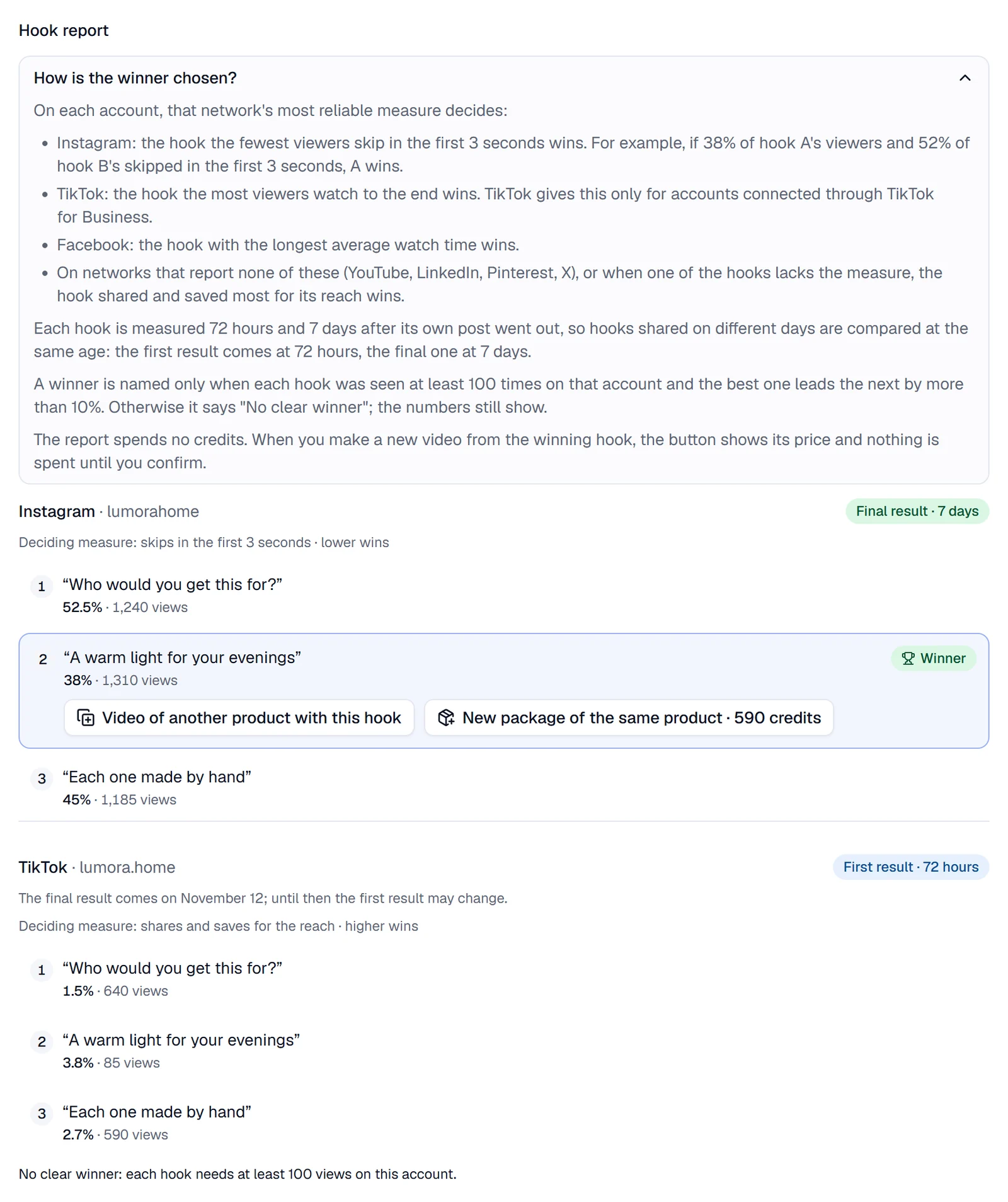
Each network measures viewing differently, so on each account that network's most reliable measure decides:
- Instagram: the hook the fewest viewers skip in the first 3 seconds wins. For example, if 38% of hook A's viewers and 52% of hook B's skipped in the first 3 seconds, A wins. Meta gives this measure for Reels only and marks it as an estimate.
- TikTok: the hook the most viewers watch to the end wins. TikTok gives this measure only for accounts connected through TikTok for Business.
- Facebook: the hook with the longest average watch time wins. For example, if A was watched for 7.2 seconds on average and B for 5.4, A wins.
- On networks that report none of these (YouTube, LinkedIn, Pinterest), or when one of the hooks lacks the measure, the hook shared and saved most for its reach wins. For example, a hook that reached 1,000 accounts and was shared 12 times and saved 8 times has a rate of 2%.
Each account's row says which measure decides and whether lower wins or higher wins. Next to each hook you see its value on that measure and how many times it was seen.
What a winner needs
So that little data does not crown the wrong hook, two conditions apply:
- Each hook must have been seen at least 100 times on that account. For example, if A was seen 1,240 times, B 1,310 and C 85, C is under 100, so it says No clear winner.
- The best hook must lead the next by more than 10%. For example, if 40% skipped A in the first 3 seconds and 43% skipped B, the hooks are about 7% apart: there is no clear winner.
Without a clear winner the numbers still show. These hooks did not differ clearly; you can decide yourself. If readings are missing, or fewer than two hooks were shared on an account, the report says No comparison on this account.
A new video with the winning hook
Two buttons sit under the winning hook. They show in the report on the Studio › Short video page and need the editor role or above. Neither spends credits at once: you see the price and confirm.
Video of another product with this hook
The short video form opens with the package's format and the winning hook; it starts with New video with the winning hook. Choose the product and its photos and pick the level; the AI carries the hook over to the product you chose. For example, if "Who would you get this for?" won for a mug, you make a T-shirt video that opens the same way.
This makes a single video: Narrated slide 25 and Standard 210 credits; Full motion 590 credits at 15 seconds and 1,150 at 30. The three-hook package can't be chosen here, because a package keeps the winning hook for the same product. Press Cancel to go back to a plain form.
New package of the same product
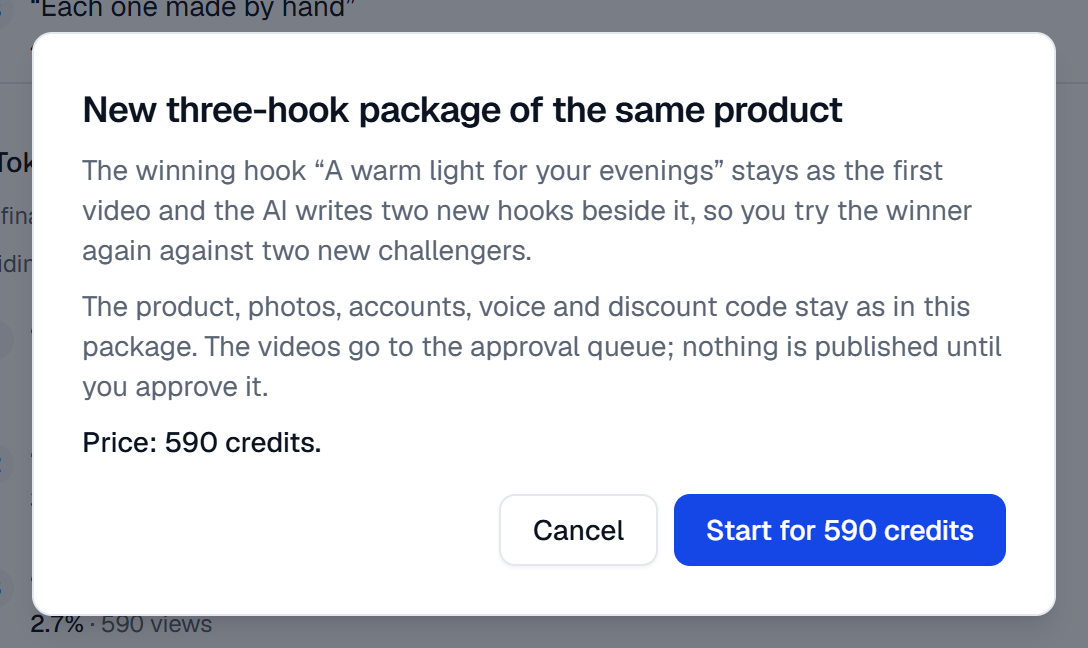
A new three-hook package of the same product is made. The winning hook's line and voiceover text stay as the first video; its opening clip and voice are made again from the same first photo and the same text. The AI writes two new hooks beside it, so you try the winner again against two new challengers. The product, photos, accounts, voice and discount code stay as in the old package. The price is 590 credits, and the videos go to the approval queue.
The new video's card says where it came from: Carried over from a winning hook or New package keeping a winning hook.
Hook reports in Analytics
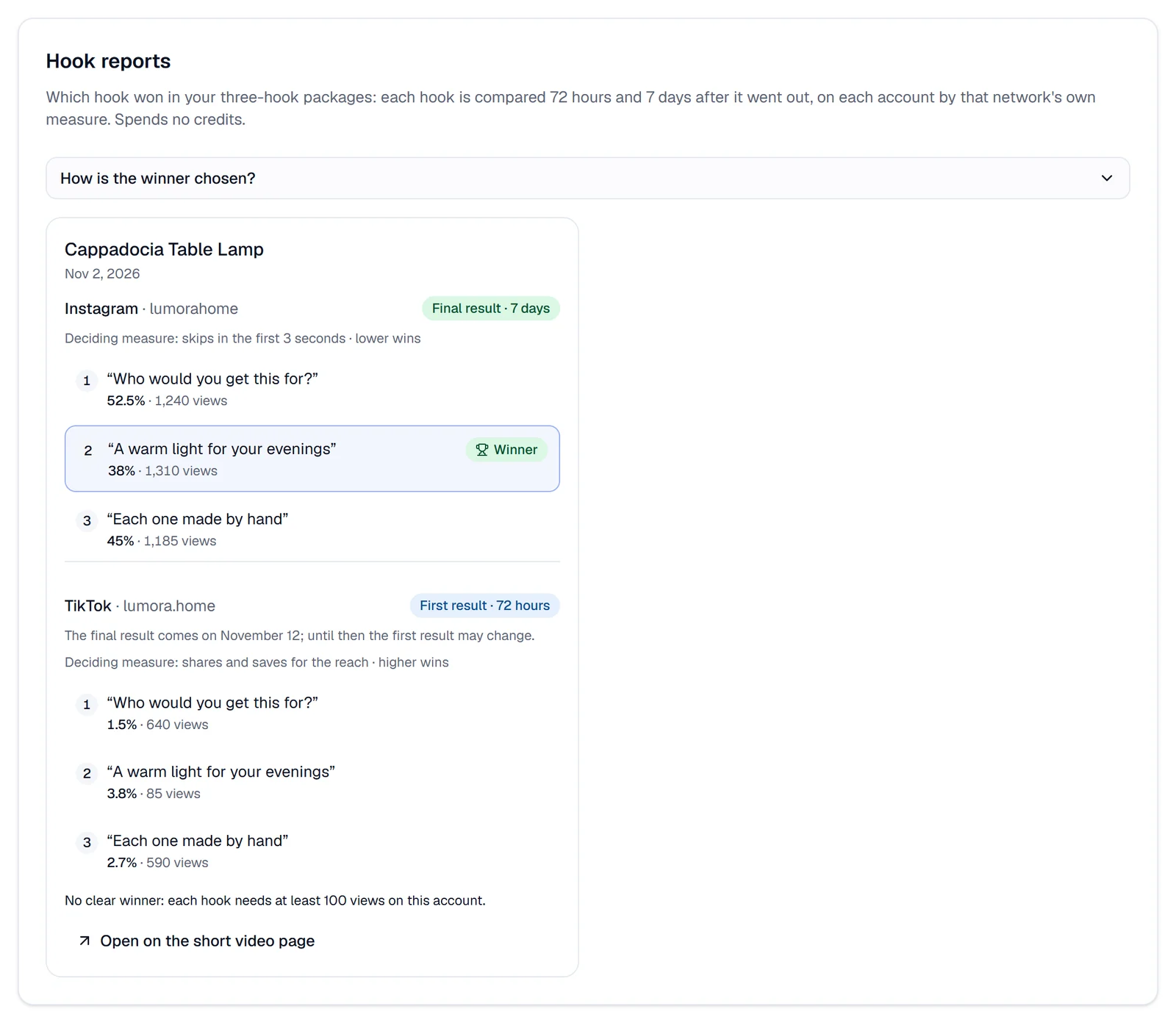
The Hook reports card on the Analytics page lists the three-hook packages with at least one hook published in the chosen period: the product, the package's date, whether automation made it, and each account's result. Everyone on the team sees the card. Editors and above go to the package with Open on the short video page and make the new video there.
The weekly summary email
If the weekly summary email is on, Monday morning's email has a Hook reports finished this week section. It lists each package and account whose final result came that week, with the winning hook or why there is no clear winner. Open the report opens the package on the short video page. No separate email comes for a report.
With an AI assistant
A connected AI assistant can read the hook reports and tell you the winning hook, the measure, or why there is no clear winner. It can't make a new video; the two buttons are in SemPost only.
If something goes wrong
- This hook can no longer start a new video: choose a hook of a package that was made. The package or the hook's video is gone. Open the report again and pick another package's winner.
- A new three-hook package keeps the winning hook for the same product, in the same language: choose that product, or make a single video for another one.
- The report keeps saying Waiting: the package's posts may not have gone out. Approve the posts in the approval queue. In test mode posts are not really published.
- No 3-second measure on Instagram: if the post is not a Reel, or Meta has not reported it yet, the report decides by shares and saves for the reach.
- No watched-to-the-end measure on TikTok: if the account is not connected through TikTok for Business, the report decides by shares and saves for the reach.